Article Search By : Mohd Azis Abdullah, Internal Audit Division UPM
Source : IIA Global
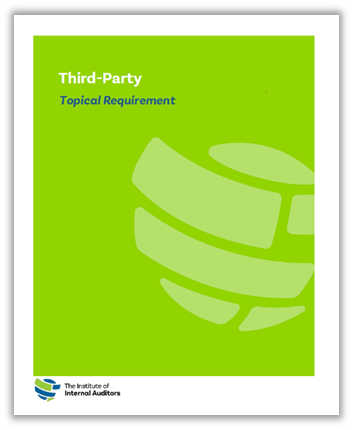
The Third-Party Topical Requirement issued by The Institute of Internal Auditors (IIA) establishes a mandatory baseline for assessing how organizations govern, manage risks, and control relationships with external service providers. It forms part of the International Professional Practices Framework and must be applied together with the Global Internal Audit Standards.
The requirement becomes applicable whenever third-party arrangements are included in the audit plan, identified as a risk during an engagement, or specifically requested for review. Internal auditors are required to document how each requirement was evaluated, including justification for any exclusions.
A third party refers to any external entity engaged to provide products or services, including vendors, contractors, consultants, outsourced providers, and subcontractors. Although operational responsibilities may be delegated, accountability for risks remains with the organization. Third-party relationships can introduce strategic, operational, financial, compliance, cybersecurity, reputational, and legal risks. Consequently, managing third-party relationships should be treated as a core component of enterprise governance and risk management rather than merely a procurement activity.
From an audit perspective, evaluation should cover the full lifecycle of third-party relationships, beginning with selection and due diligence, followed by contracting, onboarding, performance monitoring, and eventual termination or renewal. Each stage presents different risk exposures that require appropriate governance structures, documented procedures, and clearly assigned responsibilities. Effective oversight also depends on timely communication between management, procurement, risk functions, and senior leadership regarding vendor performance and emerging risks.
Risk management processes for third parties should be structured, consistent, and risk-based. Organizations are expected to conduct periodic risk assessments to prioritize vendors according to their criticality and exposure level. Appropriate risk responses must then be implemented, monitored, and adjusted when conditions change. Escalation mechanisms are also essential to ensure that vendor failures, breaches, or compliance issues are addressed promptly and that management can decide whether remediation, contract revision, or termination is necessary.
In conclusion, the Third-Party Topical Requirement reinforces the principle that outsourcing does not transfer risk ownership. Instead, it obliges organizations to establish robust governance, risk management, and control processes over external relationships. When properly implemented and audited, these practices strengthen transparency, regulatory compliance, operational resilience, and service reliability, thereby supporting the organization’s ability to achieve its objectives despite increasing dependence on external providers.
Date of Input: 16/02/2026 | Updated: 29/03/2026 | muhammad.isam
MEDIA SHARING